AI for Healthcare Administration: Where Staff Time Gets Burned
Clinical AI gets attention. Administrative AI cuts delays, no-shows, billing friction, and staff time across healthcare operations.
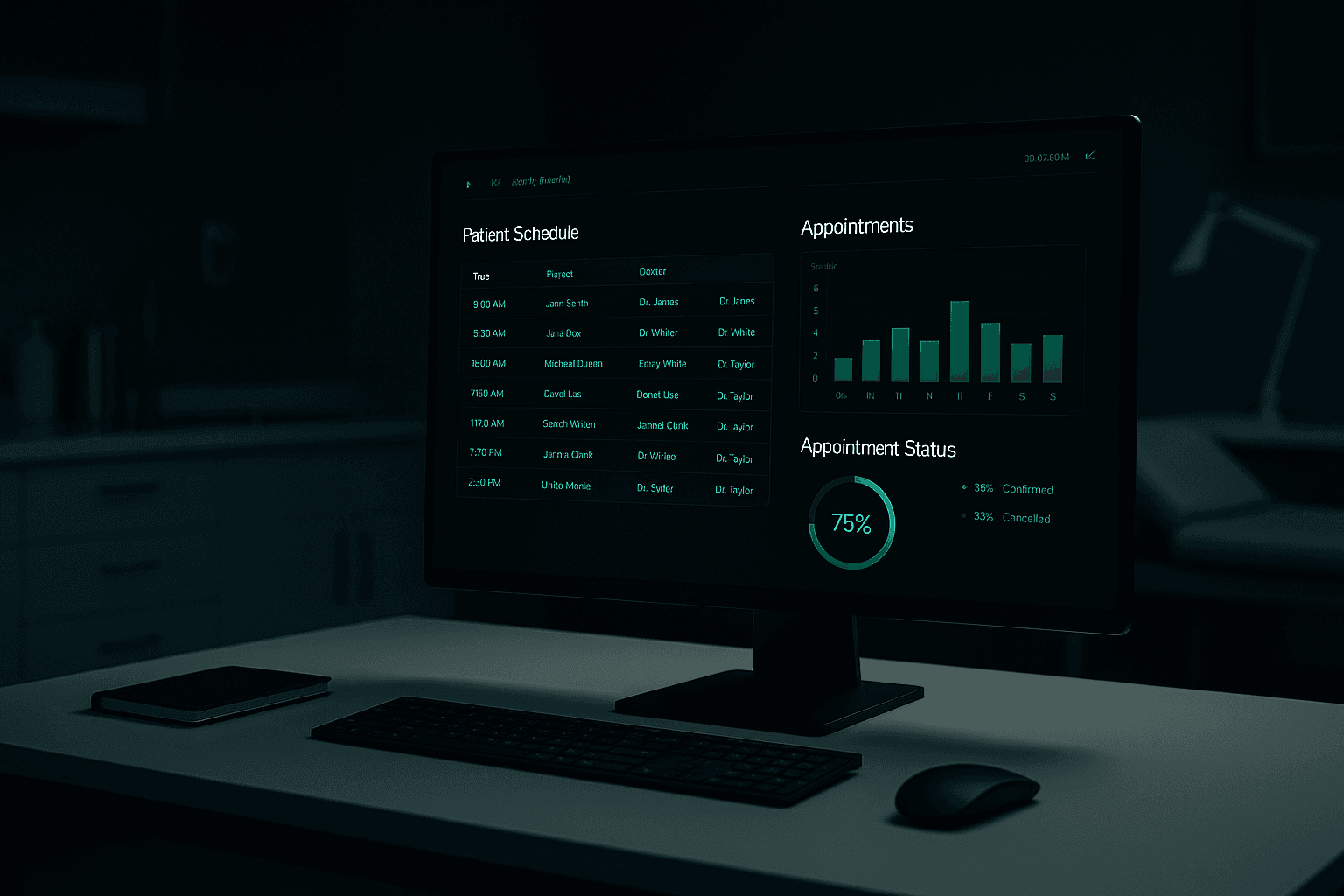
The AI conversations happening in healthcare boardrooms tend to focus on the same themes: diagnostic imaging models, clinical decision support, drug discovery pipelines. Those applications are real and they matter. They are not where most healthcare organizations have a near-term opportunity to put AI to work.
The near-term opportunity is in administration. Scheduling. Billing. Intake. Documentation. These functions consume enormous amounts of staff time at healthcare organizations of every size, they are largely rule-based, and they are generating measurable results when automated. Most of this does not make the trade press.
Where does AI help healthcare administration first?
AI helps healthcare administration first in scheduling, billing, intake, and documentation because those workflows are repetitive, rule-based, and full of manual follow-up work. They are easier to measure than clinical AI projects and usually reach ROI faster.
Where the Time Goes
In a typical outpatient practice or healthcare organization, administrative work breaks down into four categories that account for the majority of non-clinical staff time.
Scheduling and confirmation. Staff call patients to confirm appointments. Patients do not answer. Staff leave messages. Some patients call back to reschedule. Others do not show. The no-show rate in many practices runs between 10 and 30 percent. Every no-show is a slot that was blocked and cannot be recovered. The labor cost of managing this cycle manually is significant and almost entirely avoidable.
Insurance and billing. Preparing a claim requires pulling the right codes, checking them against payer rules, and submitting on time. When a claim is denied, staff must identify the reason, correct the error, and resubmit. Denial management is one of the most labor-intensive functions in healthcare administration and also one of the most rule-governed. The rules do not require human judgment to apply. They require accuracy and consistency.
Patient intake. In many practices, patients arrive and fill out paper forms. A staff member then re-enters that information into the system. The process takes time, introduces transcription errors, and produces data that varies in quality depending on how the paper form was filled out. The downstream effects of inconsistent intake data show up in billing, care coordination, and patient records.
Internal documentation. Visit notes, referral tracking, care coordination messages, and follow-up documentation take time that clinicians and care coordinators do not always have. Documentation that falls behind creates gaps in records, slows down billing, and creates liability exposure.
What AI Is Doing in These Areas Right Now
Across each of these categories, practical AI applications exist and are running in healthcare organizations today. These are not pilot programs. They are operational systems.
Automated appointment confirmation and no-show prediction. Systems that send automated reminders via text and track response rates have been around for years. The AI layer adds no-show prediction: using historical appointment data to identify which patients are at elevated risk of not showing up, then flagging those appointments for proactive outreach or overbooking. Practices that have deployed this report measurable reductions in no-show rates and a corresponding increase in filled slots.
Claims pre-validation. Before a claim is submitted, an AI system checks it against the specific payer's rules to flag likely denial causes. This catches errors before submission rather than after. The result is a higher first-pass acceptance rate and less time spent on denial management. The rule sets for payer adjudication are complex but they are documented. This is pattern matching applied to a large rule base, which is exactly what AI does well.
Digital intake. Patients complete intake forms on their own devices before arriving. The data flows directly into the system without manual re-entry. Form logic adapts to patient responses, so the questions are relevant to each patient's situation rather than generic. Data quality improves because patients are entering information directly rather than through a transcription step. Staff time at check-in shifts to exceptions rather than routine data collection.
What Makes Healthcare Different
Healthcare AI implementation is more complex than comparable projects in other industries. The primary reason is data sensitivity and the compliance requirements that come with it.
HIPAA sets specific technical and administrative requirements for any system that handles protected health information. Those requirements are not optional and they are not simple. They cover how data is stored, transmitted, accessed, and audited. Any AI system that touches patient data needs to be built and operated against these requirements. Vendors who cannot demonstrate HIPAA compliance should not be in the conversation.
This complexity is not a reason to avoid AI in healthcare administration. It is a reason to be deliberate about vendor selection and implementation partnership. The compliance requirements add cost and time to implementation. They do not change the ROI math when the underlying workflow savings are real.
FAQ: What should healthcare teams automate first?
What is the safest first workflow?
Scheduling and billing are usually the safest first workflows because they avoid some of the complexity tied to deeper clinical data use.
Why not start with clinical AI?
Clinical AI usually brings more compliance complexity, more risk, and a longer path to adoption than administrative workflows.
What makes healthcare AI harder than other industries?
The combination of sensitive data, compliance requirements, audit expectations, and system fragmentation makes healthcare AI implementation more demanding.
Where to Start
For healthcare organizations that want to start applying AI to administration, the lowest-risk entry point is workflows that do not directly touch clinical data. Scheduling and billing are the fastest path to measurable impact with the lowest compliance complexity.
Scheduling optimization does not require access to clinical records. It requires appointment data and communication history. Billing pre-validation requires claim data and payer rule sets. Neither involves clinical notes or diagnostic information. The compliance requirements are more manageable, the implementation timelines are shorter, and the ROI is easier to measure.
Once those workflows are running and the team has developed familiarity with AI-assisted operations, the organization is better positioned to take on more complex clinical-adjacent applications.
If you want a clearer picture of where AI is generating returns in healthcare administration and how your organization compares, our healthcare AI overview covers the specific use cases in depth. The AI competitive audit is the right starting point if you want a structured view of your current position.
Get the weekly AI brief.
Read by CIOs and ops leaders. One insight per week.