Workflow Automation: Stop Adding AI to Broken Processes
Learn why adding AI to broken processes kills ROI and what to fix in the workflow before automation goes live.
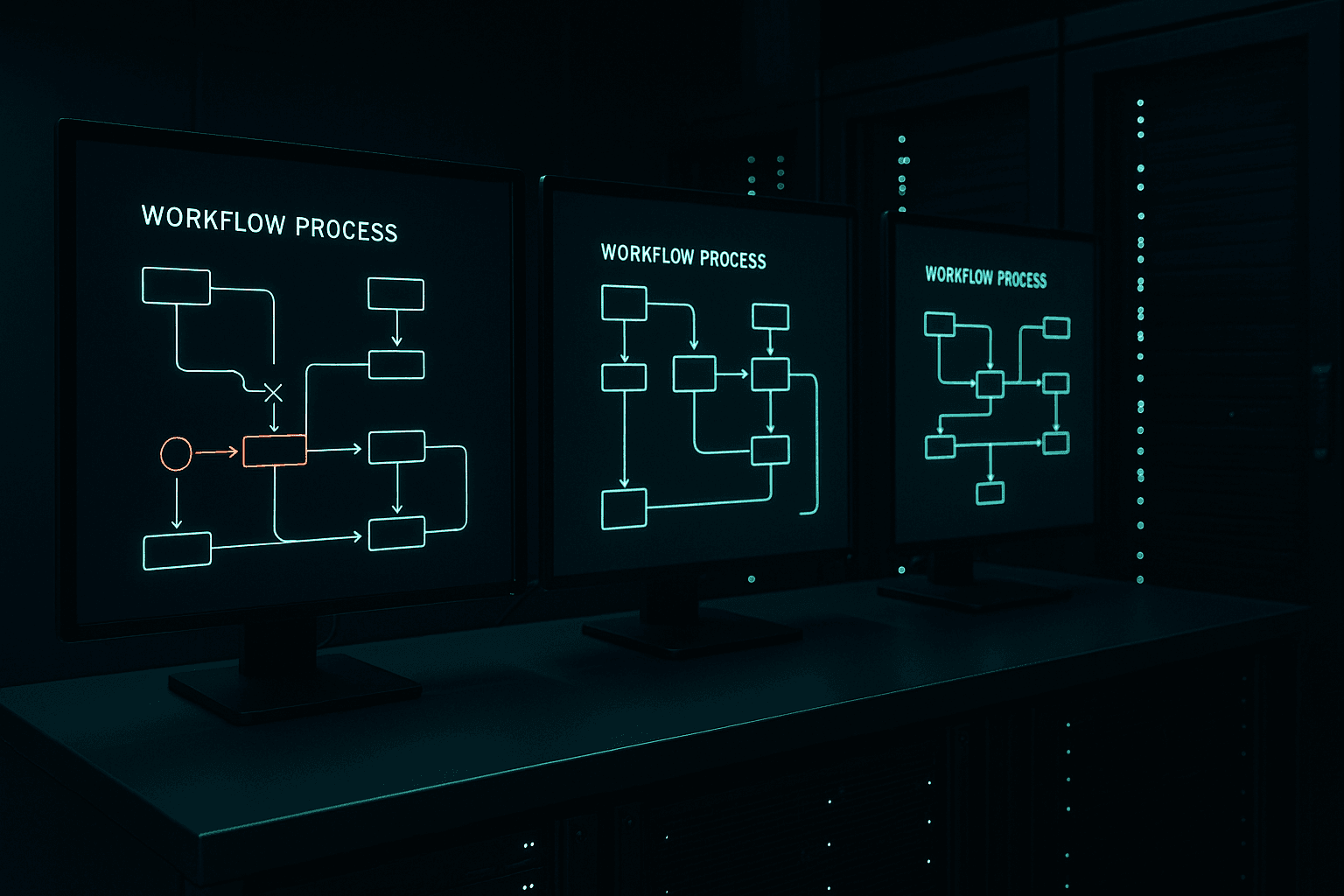
Most companies approaching AI agents make the same mistake. They take an existing process, find the slowest step, and ask an AI agent to do that step faster. It feels productive. It ships quickly. And it leaves 80% of the value on the table.
The real opportunity requires a harder question: if you were designing this process today, knowing that AI agents write code, call APIs, and run tasks in parallel, what would this process look like?
The answer, in most cases, looks nothing like what you have now.
The Gap That Is Already Forming
A divide is emerging between two types of organizations. The first type layers AI onto existing processes. They automate a manual step here, summarize a document there. They get a 15-20% efficiency gain and call it a win.
The second type redesigns the process itself around what AI agents do well. They restructure how data flows, how decisions get made, and how tasks get sequenced. They get 3-5x throughput improvements because the workflow was built for the technology, not retrofitted with it.
This pattern is not new. When e-commerce emerged, the companies that won did not digitize their paper catalogs. They redesigned the entire buying experience around what the web made possible: search, filtering, reviews, recommendations, one-click purchasing. The companies that treated the web as a faster fax machine lost.
AI agents are the same inflection point for business operations.
What Makes AI Agents Different
AI agents have three capabilities that break traditional workflow assumptions.
First, they write and execute code on demand. An agent connecting your CRM to your invoicing system does not need a six-month integration project. It writes the integration, tests it, and runs it. When requirements change next quarter, it writes a new one.
Second, they run tasks in parallel. A human reviews supplier applications one at a time. An agent reviews 50 simultaneously, flagging only the ones that need human judgment.
Third, they interact with any system that has an API. Your marketing platform, your accounting software, your project management tool, your data warehouse. An agent moves between these systems the way a senior engineer would, except it does not need onboarding and it does not take PTO.
Here is the mental model that makes this concrete: picture an unlimited number of capable engineers who write custom software for any process in your business, on demand, at near-zero cost. What would you ask them to build? What manual steps would disappear? What connections between systems would you finally make?
That mental model is becoming operational reality. But it only works if your workflows are designed to take advantage of it.
Where This Matters Most (And Where It Does Not)
Not every process benefits equally from ground-up redesign. The key is understanding which characteristics make a workflow a strong candidate.
Redesign works best when the bottleneck is connecting data across systems, running parallel validations, generating variations of output, or executing repetitive structured tasks. These are processes where "write more software" solves the problem.
Consider your monthly financial close. The traditional process involves a team manually pulling data from multiple systems, reconciling discrepancies in spreadsheets, generating reports, and routing them for approval. Each step waits for the previous one. The whole cycle takes 5-10 business days.
Redesigned for AI agents, the process looks completely different. Agents pull data from every source simultaneously. They write reconciliation scripts specific to each data discrepancy they find. They generate the reports and pre-flag anomalies for human review. The human role shifts from data wrangling to judgment calls on the 5% of items that need attention. The cycle compresses from days to hours.
Now consider a process like strategic vendor negotiation. The bottleneck is not data or software. It is relationship management, reading a room, understanding a supplier's unstated constraints, and making judgment calls about long-term partnerships. An AI agent adds marginal value here. Redesigning this process around agents is a waste of time.
The practical framework: look at each workflow and ask what percentage of the bottleneck is "we need more software connecting more data" versus "we need better human judgment on ambiguous decisions." Redesign the first category aggressively. Augment the second category incrementally.
A Before-and-After: Marketing Campaign Execution
Here is what this looks like in practice for a company running marketing campaigns.
The current process: A marketing manager identifies an audience segment. They brief a designer. They write copy. They set up the campaign in the email platform. They configure tracking. They launch. They wait for results. They pull data into a spreadsheet. They build a report. They present findings. Total cycle time for one campaign: 2-3 weeks.
Redesigned for agents: The marketing manager defines the campaign objective and target segment. An agent pulls historical performance data from past campaigns targeting similar segments. It generates multiple copy and subject line variations. It configures the campaign in the email platform via API, including A/B test variants. It sets up tracking and attribution. After launch, it monitors performance in real time, generates an analysis comparing results against benchmarks, and delivers a summary with recommendations for the next iteration. Total cycle time: 1-2 days, with the human focused on strategy and creative direction rather than platform configuration and data pulling.
The difference is not "AI made each step 20% faster." The difference is that the workflow has fewer steps, runs tasks in parallel, and reserves human attention for decisions that require human judgment.
How to Start
You do not need to redesign every process at once. Start with this:
Pick three workflows that consume significant team hours each week. For each one, write down every step and identify where the bottleneck is data movement, system integration, or repetitive structured work versus human judgment on ambiguous inputs.
For the workflows where data and integration dominate, sketch what the process would look like if an engineer built custom software for every connection and every repetitive step. That sketch is your target architecture for AI agents.
Then build one of them. Get it working. Measure the difference. Use that result to build organizational momentum for the next one.
The teams that start thinking this way will operate fundamentally differently within 12-18 months. The question is whether your team will be one of them.
Dooder Digital helps companies redesign work for AI, not bolt AI onto existing work. Start with a free AI workflow audit.
Get the weekly AI brief.
Read by CIOs and ops leaders. One insight per week.