AI Agent Implementation: The Workflow Work Most Teams Skip
AI agent implementation fails when teams skip workflow redesign, change management, and system cleanup. See the work that makes agents useful.
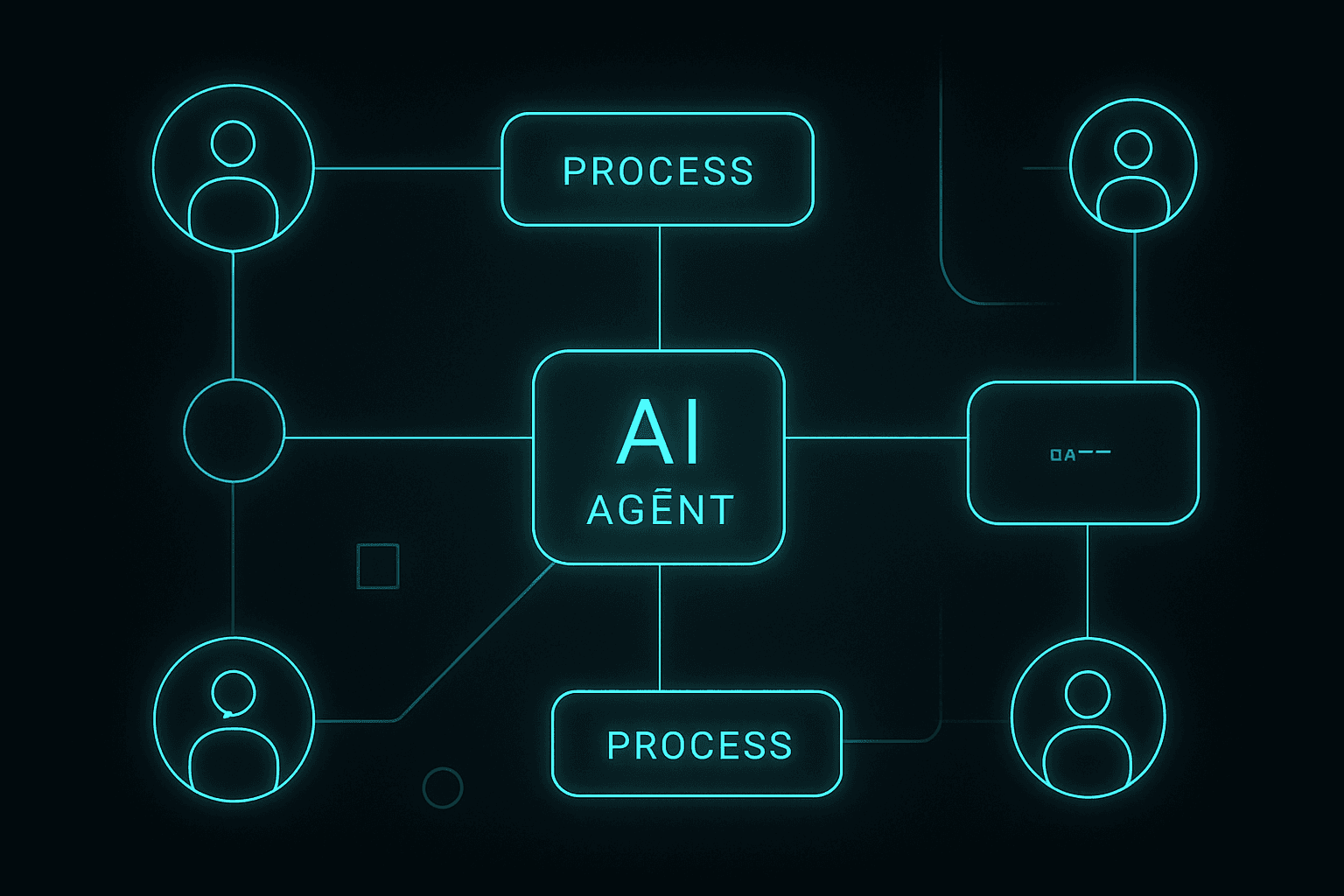
AI agents are here. They write code, summarize documents, draft emails, and answer questions. But deploying an agent into a business workflow is a different problem entirely.
The gap between "we have AI agents" and "AI agents do useful work in our business" is filled by people. Specifically, people inside the organization who understand how work gets done today and redesign it so agents get what they need to contribute.
This is one of the most valuable skill sets emerging right now. Most organizations are underinvesting in it.
Why Agent Deployment Is Hard Outside Engineering
Coding agents get all the attention because they deliver results fast. The reason is environmental. Developers work inside structured systems with clear rules, typed inputs, version history, and immediate feedback. The agent fits neatly into a workflow built for machines.
Most of the organization does not look like this. Think about how a procurement team evaluates a new vendor. The process touches email, spreadsheets, a contract repository, a compliance checklist stored on someone's desktop, and two approval steps that exist only as verbal agreements. No one has documented the full sequence. The knowledge lives in people's heads.
An AI agent dropped into this environment has no starting point. It does not know the steps, does not know where the information lives, and does not know which decisions require a person.
Before an agent produces value here, someone has to rebuild the foundation. The existing process needs to be examined and often redesigned from scratch, because the current version was built around human judgment calls agents handle differently. Systems that store relevant data in silos need bridges between them. Information trapped in documents, emails, and spreadsheets needs to be made machine-readable. And the boundaries between agent work and human judgment need clear rules: what gets automated, what gets flagged for review, and what stays fully manual.
None of this work is optional. Models will keep improving, but the business-specific knowledge required to make an agent useful in a particular workflow still comes from people who understand the workflow deeply.
History Gives Us a Warning
This is not the first time a technology wave created demand for "people who make the new thing work." Business Process Reengineering in the 1990s had the same pitch. ERP implementations in the 2000s required teams of people who understood both the technology and the business process. RPA in the 2010s created roles for people who mapped workflows and built bot automations.
In each case, early movers captured significant value. And in each case, the work eventually got commoditized, absorbed into existing roles, or outsourced.
The honest question for this wave: why would AI agent integration be different?
Two reasons stand out. First, agent capabilities are evolving fast enough that the integration work is not a one-time project. Unlike an ERP implementation that stabilizes after go-live, agent-powered workflows need continuous tuning as models improve and new capabilities become available. The person who set up the workflow last quarter needs to revisit it this quarter because the agent is now capable of handling steps that previously required human review.
Second, the scope is broader. ERP touched finance and operations. RPA touched repetitive, rules-based tasks. AI agents touch every knowledge work function. The surface area of integration work is larger, which makes it harder to consolidate into a single team or outsource to a single vendor.
Organizations should be clear-eyed: if you treat this as a temporary project staffed by contractors, you will get temporary results. The companies that build this as an internal capability will compound their advantage over time.
The Real Bottleneck Is Organizational, Not Technical
The hardest part of deploying AI agents into workflows is not the data structuring or the system integration. It is getting the organization to change the process.
Every workflow has an owner. That owner built or inherited the current process and has incentives tied to it. Asking them to redesign it for AI agents means asking them to accept risk, learn new tools, and give up control of steps they currently manage. It is a change management problem, not a technology problem.
The people who succeed in this space combine technical understanding of what agents need with the organizational skills to drive process change. They need to speak the language of the business unit, understand the incentives of the process owner, and build trust the redesigned workflow produces better outcomes.
This is why the skill set is more than "prompt engineering" or "AI literacy." It is process design, data architecture, systems thinking, and stakeholder management, all applied to a specific business context.
What This Means for Organizations
If you lead a team or a function, here is what to act on.
Identify two to four workflows where agents have the highest potential impact. Look for processes with high volume, significant manual data handling, and clear quality criteria for outputs. Start there.
Assign a dedicated person or small team to the integration work. Do not distribute this across existing roles and hope it gets done. The organizations that do this well treat it as a focused initiative with clear ownership, not a side project.
Expect iteration, not a one-time deployment. The first version of any agent-powered workflow will need adjustment. Build in review cycles. Track where the agent fails, where humans override it, and where the process itself needs to change.
Invest in the organizational change, not the technology. The models and tools are the easy part. Getting your team to trust a new workflow, validating outputs, and adjusting roles and responsibilities around agent capabilities is where the effort goes.
A Career Opportunity Hiding in Plain Sight
The people closest to a broken process are usually the best positioned to fix it. In most organizations, that means the person who spends their day copying data between systems, chasing approvals over email, or reformatting reports for the third time. They know exactly where the friction is because they feel it every day.
If you are early in your career, this is a strategic advantage. Start by picking one workflow you touch regularly and documenting it end to end. Learn how APIs and automation platforms connect systems. Study how data needs to be structured for an agent to use it. Then build a proof of concept that eliminates ten to fifteen hours of manual work per week from that single workflow.
The people doing this work now, while most organizations are still figuring out what agents are for, will be running AI programs at scale within a few years.
It requires patience. It means sitting with colleagues in other functions and learning how they do their jobs before proposing any changes. It is not flashy work. But the organizations that figure this out will operate at a different speed than those that do not. And the people who did the work will be the ones who made it possible.
Start With One Workflow
Dooder Digital works with CIOs and operations leaders to identify the highest-value workflows for agent integration, map the redesign required, and build the internal capability to run and improve agent deployments over time.
If your organization has agents in production or is planning to deploy them, start with a 30-minute workflow assessment. Book a briefing at dooder.ai/schedule-call.
Get the weekly AI brief.
Read by CIOs and ops leaders. One insight per week.